Global Change
Meteorology/Agronomy/Env. Science/Env. Studies 404/504
Spring 2015, MWF 11:00-11:50 p.m.
Room G541 Agronomy
|
Instructor |
Teaching
Assistant |
(Image courtesy of http://earthobservatory.nasa.gov)
Course Description
Current understanding of how climate evolves under natural and human
influences. Global energy balance, structure and circulation of the
atmosphere and oceans, role of land and snow/ice processes, climate
variability, climate modeling, implications of climate change for
natural and human systems, policy and ethical issues of climate change.
Course Objectives
To understand
Structure of Course
Some meetings during the semester may be devoted to a seminar-style
format where we will critique current journal articles in various relevant topics or
do other types of class exercises. In some cases, a laptop or other
internet-ready device may be useful.
This course is administered through Blackboard
Learn. You will need to use
it for a variety of course ativities (quizzes, exams, lectures, some discussions, some
computations, etc.) The course is listed there as
MTEOR/AGRON/ENSCI/ENV_S 404/504 (Spring 2015) for all
students registered in this course, whether 404 or 504 and whatever of
the cross-listings you registered under.
You should order this book
from Amazon.com (Go to a
direct link here) or other preferred book seller. (It's possible that the Union bookstore might have a few
copies on hand.) I do provide scans of early readings in the
course, since you most likely will not have the book already. They
will appear in the Media Library.
Quizzes
Quizzes are administered through Blackboard Learn. Quizz previews are available for download ahead of time. Watch for notices from me.
You may find it useful to look at the quiz preview first before attempting to take it online. The quiz preview includes all the questions in the actual quiz, plus additional questions.
Seminar
The in-class seminar meetings will require participation a written report and participation in discussion by break-out groups and, on occasion, a written report. You should read the further details for seminar reports. Attendance is required for seminar meetings and other in-class exercises.Major, overriding concepts (not specific details) from each assigned seminar paper are fair game for exam questions.
Discussion Groups
Online discussion and classroom exercises will use assigned discussion groups. You can download the discussion group list. (I will notify you when it is available.) Groups are designed to provide a mix of the backgrounds of students in the class, but also be small enough that everyone should feel they have opportunity to contribute.Class Exercises
Online Dialogue
The discussion will use Blackboard's tools to organize it. The online discussion focuses on a particular topics of interest in climate change. Further information on how to contribute to the dialogue and grading criteria appears at this location.For 504 (graduate-level) students: some of the online dialogue may require a written report in addition to participation in online discussion by break-out groups. You should read the further details for online dialogue reports. The online discussion and other online activities contribute to your grade.
Major, overriding concepts (not specific details) from each assigned seminar paper are fair game for exam questions.
Exams
Exams will be administered to on campus (or nearby students) through the Iowa State's Engineering-LAS Online Testing Center. You should go to this link before your exams to find the locations and to review the General Instructions and the Rules. Note especially the strict rules of operation for the center, including the hours of access. Also, taking an exam early in an exam period is generally better than doing it later, as you may encounter delays from heavy usage of the Testing Center.If you are too far from campus to use the Online Testing Center, you must make provisions to have a qualified proctor administer your exam! Please do this early in the semester to avoid problems with trying to rush approvals. You should read the information on Proctored Testing under all the categories on that page. There are strict requirements that the proctor and the site of the proctored exam must satisfy. Make sure that both you and the prospective proctor read these requirements first before filling out any application. Please be sure that you can satisfy these requirements early in the course. Note that the proctor must fill out an Off-Campus Proctor Application.
Term Papers
Note the first deadline: January 30, for paper topics.
Grading
404 (Undergraduate level)
| Quizzes | 25 % |
| Seminar Participation and Reports | 20 % |
| Mid-term Exam | 25 % |
| Final | 30 % |
504 (Graduate level)
| Quizzes | 10 % |
| Seminar Participation & Critiques | 15 % |
| Mid-Term Exam | 20 % |
| Final | 30 % |
| Term Paper & Oral Presentation | 25 % |
I communicate frequently with the class by email.
The email address I have for all students is their @iastate.edu address. Students who prefer to use some other email address should follow these instructions to automatically forward your iastate.edu email to another system.
When sending email to me, please start the SUBJECT line with the words "Global Change". This will help me greatly in finding your emails to me.
Pre-recorded Lectures
I use pre-recorded lectures for the core of the course material. To view and listen to them, you simply need to click on the link for the lecture identified as pre-recorded lectures in the course schedule, so long as you have an appropriate browser with the Macromedia Flash Player extension included. Typically, this extension is already in your browser, but if it is not, you will be asked if you want it downloaded and installed on your machine. Basically, Windows and Macintosh OS X machines are ok. Linux machines should work, but success is not guaranteed.I would like to know about whatever problems you encounter, so please send me an email on those, even if you fix the problem yourself.
For best visual clarity, you should make your browser window as large as possible. If you are listening to the lectures with others around you, out of courtesy, please use headphones.
Acknowledgment
This offering of Mteor/Agron/EnvSci/EnvSt 404/505 is a major revision of the version taught for several years by Prof. Gene Takle. Despite these changes, the overall goals and inspiration for the course stems from the earlier developments by Prof. Takle, whose efforts are much appreciated.
W. Gutowski's Away Schedule
Because I am actively involved in research on climate change and its impacts, I will have to be out of town at times during the semester for various program and project meetings. Some of this will involve my ongoing work with the World Climate Research Programme (WCRP).
In all cases, I should have access to email during at least part of the time I am away. Please keep in mind that I may not be in the same time zone, so replies may be slow. Since nearly all of the course is available and can be followed online, through Blackboard and the class web page, I hope my travel will not be much of a disruption.
My travel schedule:
Other meetings may occur during the semester, but I will try to avoid them as much as possible and let you know well in advance.
Course Schedule
|
Module |
Date |
Topic |
Source |
Other Materials |
|
|
1 |
12 January 2015 |
Introductions
|
- |
Assigned reading:Schmidt & Wolfe - Preface, p. xi-xii; Introduction, p. 1-3 | |
|
1 |
14-16 January 2015 |
Overview of Climate Change Science Pre-recorded lecture: Summary for Policy Makers - AR4 Pre-recorded lecture: Uncertainty Guidance - AR4 |
IPCC Working Group-I |
Background (from earlier GC courses)
Assigned reading: S&W - Introduction, p. 7-9 |
|
|
|
19 January |
ML King Day |
|
|
|
|
1 |
21 January 2015 |
Historical Overview |
IPCC Reports AR4-WGI-Chapter 1 |
Historical overview from the American Institute of Physics | |
|
1 |
23 January 2015 |
IPCC Reports AR4-WGI-Chapter 2 |
Assigned reading: S&W - Commonly Used
Terms, p. 10-15
|
||
|
2 |
26 - 30 January 2015
|
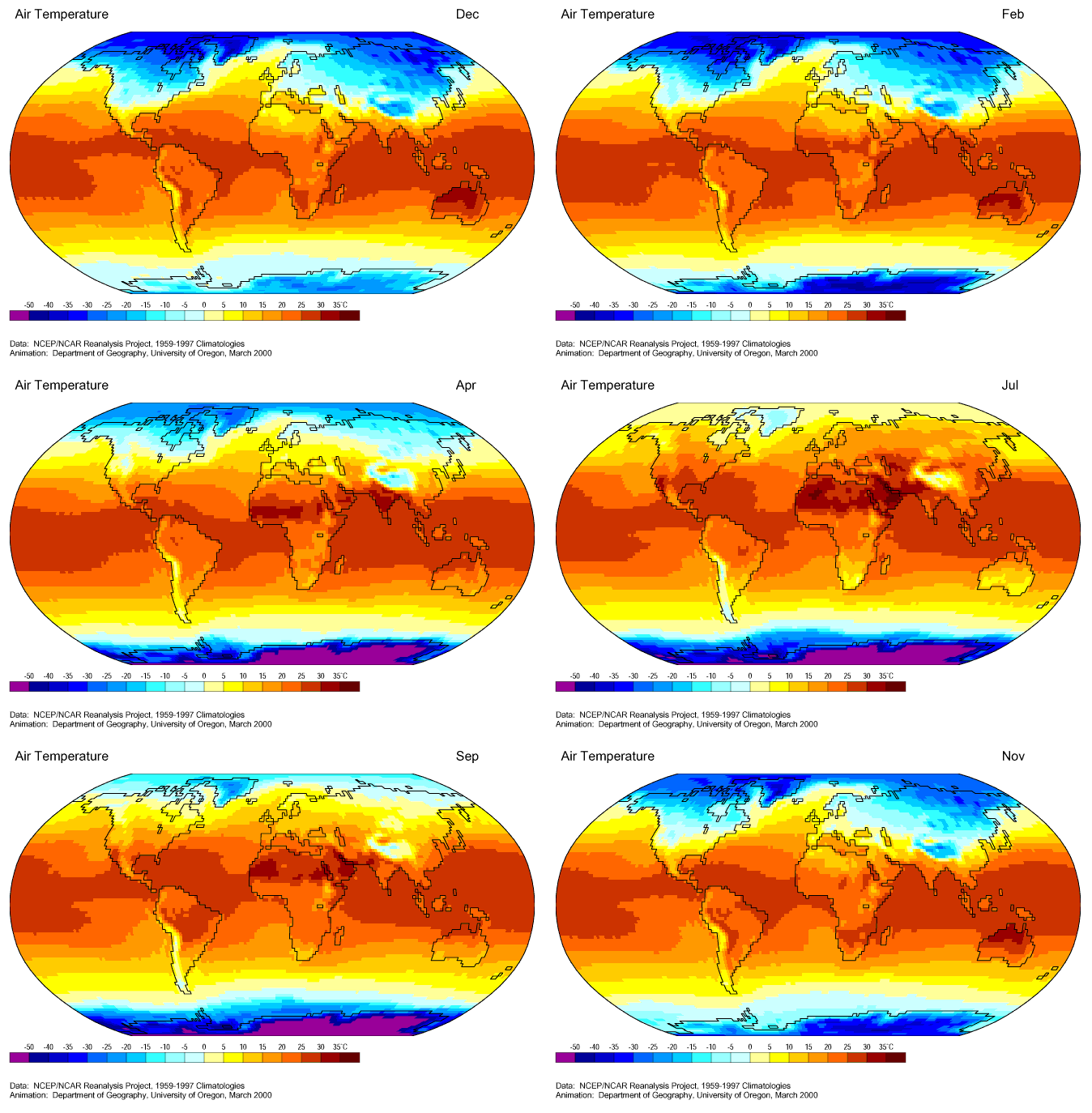
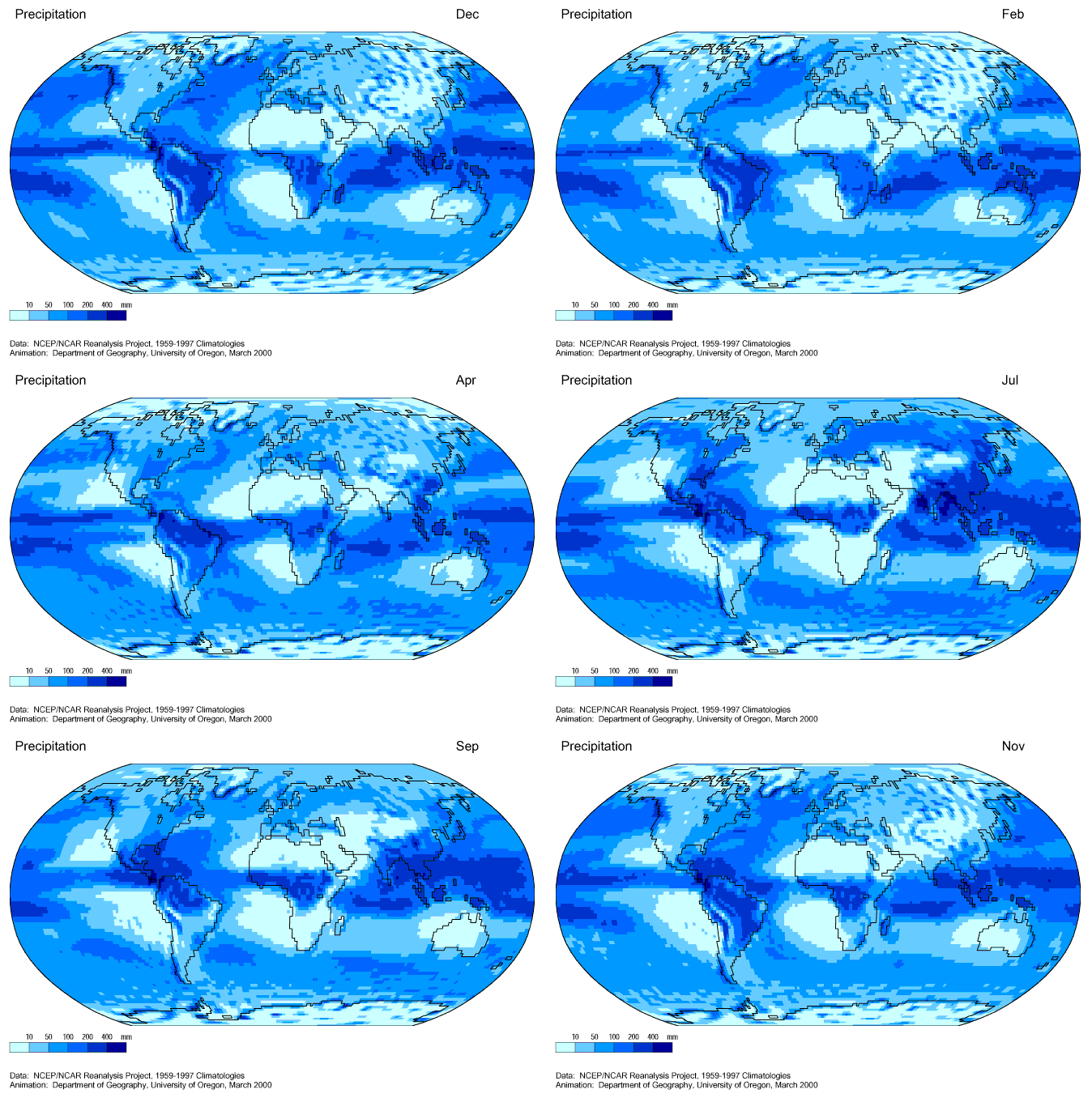
Observed Climate: Surface & Atmosphere Animations in the lecture: |
IPCC Reports AR4-WGI-Chapter 3 |
Assigned reading: S&W - 19-27.
Animations of climatic fields (courtesy of Geography Dept., Univ. Oregon) |
|
|
|
30 January 2015 |
504 term paper topic due | |||
|
2 |
2 February 2015
|
Observed Climate: Snow, ice, permafrost
|
IPCC Reports AR4-WGI-Chapter 4 |
Assigned reading: S&W - 27-34
Assigned reading: Box 4.1 in AR4-WGI-Chapter 4 (page 367) |
|
|
2 |
4 February 2015 |
Observed Climate: Oceans & Sea Level |
IPCC Reports AR4-WGI-Chapter 5 |
Assigned reading: Box 5.1 in AR4-WGI-Chapter 5 (page 397) |
|
|
2 |
6 February 2015 |
IPCC Reports AR4-WGI-Chapter 6 |
Assigned reading: S&W - p.135-148 Assigned reading: Box 6.3 in AR4-WGI-Chapter 6 (page 461) Assigned reading: FAQ 5.1 in AR5-WGI-Chapter 5 (page 392) |
||
|
2 |
9 February 2015 |
In-class exercise (attendance required): |
Letter co-signed by W. Gutowski to governor, legislature & presidential candidates (November 2011): |
||
|
3 |
11-13 February 2015 |
Biogeochemistry & Climate
(Note: For part of this topic, you should follow the online lecture.) |
IPCC Reports AR4-WGI-Chapter 7 |
Assigned reading: S&W - p.148-155 Assigned reading:Box 7.4 in AR4-WGI-Chapter 7 (page 540) Assigned reading:FAQ 6.2 in AR5-WGI-Chapter 6 (page 544) |
|
|
3 |
13 February 2015 |
In-class exercise (attendance required)
Notes from the class discussion. |
|
| |
|
3 |
16-18 February 2015 |
IPCC Reports AR4-WGI-Chapter 8 |
Assigned reading: S&W - p.73-80 Assigned reading:Box 8.1 in AR4-WGI-Chapter 8 (page 632) Assigned reading:FAQ 9.1 in AR5-WGI-Chapter 9 (page 824) |
||
|
3 |
20 February 2015 |
IPCC Reports AR4-WGI-Chapter 8 |
Assigned reading: S&W - p.195-199 Assigned reading:Box 9.2 in AR5-WGI-Chapter 9 (page 769) |
||
|
3 |
23-27 February 2015 |
IPCC Reports AR4-WGI-Chapter 9 |
Assigned reading: FAQ 9.1 (page 696) and FAQ 9.2 (pages 703-703) in AR4-WGI-Chapter 9 (page 632) Assigned reading: FAQ 10.1 (pages 894-895) and Box 10.1 (pages 875-876) in AR5-WGI-Chapter 10 (page 632) |
||
|
4 |
2-6 March 2015 |
|
IPCC Reports AR4-WGI-Chapter 10 |
Assigned reading: S&W - p.199-209 Assigned reading: SRES Emissions Scenarios and FAQ 10.1 (page 783)in AR4-WG1-Chapter 10. Assigned reading: Box 11.1 (pages
959-961) and FAQ 11.1 (pages 964-965) in
AR5-WGI-Chapter 11
|
|
|
|
9 March |
504 term paper outline due | |||
|
|
9 - 13 March 2015 |
MID-TERM EXAM
|
IPCC Reports AR4-WGI-Chapters 1-8 + AR5 equivalent |
||
|
4 |
9-13 March 2015 |
IPCC Reports AR4-WGI-Chapter 11 |
Assigned reading: S&W - p.95-111 Assigned reading: FAQ 13.1 (pages 1148-1149) in
AR5-WGI-Chapter 13
| ||
|
|
16-20 March |
Spring Break |
|
|
|
|
4 |
23 March 2015 |
IPCC Reports AR4-WGI-Chapter 11 |
- |
||
|
5 |
25 - 30 March 2015 |
Impacts: Water Resources |
IPCC Reports AR4-WGII-Chapter 3 |
Assigned reading: Box 3.1 (page 195) and Box 3.2 (page 197) in WG-II, AR4-WGII-Chapter 3 |
|
|
5 |
1-3 April 2015 |
Impacts:
Ecosystems
|
IPCC Reports AR4-WGII-Chapter 4 |
- |
|
|
5 |
3 April 2015 |
In-class exercise (attendance required)
Notes from the class discussion. |
|
- |
|
|
5 |
6 April 2015 |
Impacts: Human Health |
IPCC Reports AR4-WGII-Chapter 8 |
Assigned reading: Box 8.4 (page 403) and Box 8.5 (page 413) in WG-II, AR4-WGII-Chapter 8 |
|
|
|
6 April |
504 term paper due for peer review | |||
|
5 |
8-10 April 2015 |
Impacts: Agriculture
|
|
- |
|
|
5 |
13 April 2015 |
Impacts:
Coastal Systems
|
IPCC Reports AR4-WGII-Chapter 6 |
- |
|
|
6 |
13 April 2015 |
In-class exercise (attendance required)
|
Kalnay slides on population issues. |
||
|
|
13 April |
504 term paper peer reviews due | |||
|
6 |
15-20 April 2015 |
- |
- |
||
|
7 |
22 April 2015 |
Development of a Climate Change Assessment: An
Example - old version
|
U.S. Climate Change Science Program (CCSP) Synthesis and Assessment Report 3-3 |
Supplementary Documents NOAA news release and companion brochure |
|
|
7 |
24 April 2015 |
Future Directions (updated) |
- |
- |
|
|
|
27 April |
504 term paper: Final versions due | |||
|
|
27 April 2015 |
|
|
|
|
|
|
29 April 2015 |
(Do finishing work for the class) |
- |
|
|
|
|
1 May 2015 |
(Do finishing work for the class) |
- |
|
|
|
|
2-8 May 2015 Hours: See ELO Testing Center hours. |
Final Exam
|
The Testing Center schedule for exams may change. Watch
for announcements about this.
Additional Sources of Information:

|

|

|
(Images courtesy of USGS EROS Data Center: Himalayas, Deforestation in Bolivia, Namibian Desert)